
Health screening identifies prostate cancer diagnosis for LMH Health lab supervisor
Sharing a cancer diagnosis is an intensely personal act. After reading an article from LMH Health in September recognizing Prostate Cancer Awareness Month, Scott Mersmann knew that sharing his story would help others.
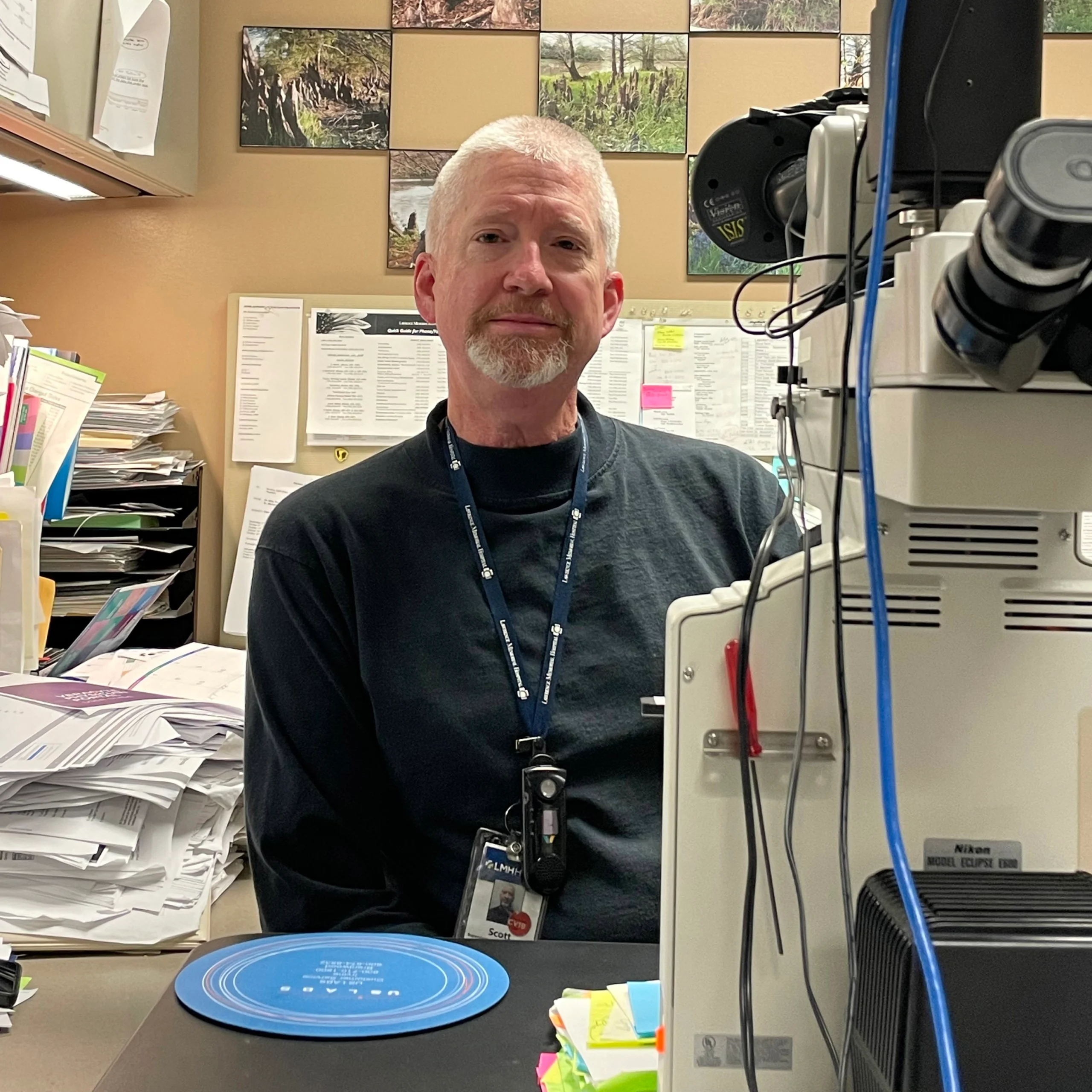
Scott Mersmann
“Spending my adult life working in healthcare, particularly in pathology, I feel a sense of responsibility that outweighs my preference to remain behind the scenes,” said Mersmann, a cytologist and the anatomic pathology supervisor at the LMH Health laboratory. “My recent diagnosis and successful surgery – all predicated on PSA screenings – serve as an example of how screening works.”
Mersmann received yearly health screenings, including prostate-specific antigen (PSA) tests. These tests measure the presence of PSA in the bloodstream and is usually the first step in diagnosing prostate cancer.
Over time, Mersmann’s PSA levels had been slowly rising. According to the American Cancer Society, most men without prostate cancer have PSA levels under four. Men who have levels between four and ten have about a 25% chance of having prostate cancer. When his level rose above four in early 2021, he started to get a little nervous.
“I was already seeing an oncologist because I’d been diagnosed with lymphoma in 2020,” Mersmann said. “They rechecked my PSA level three months later and it had gone up, but then it went down a little bit three months later. Based on that, I thought things were fine.”
Rising fears
When Mersmann had a health assessment in 2022, the screening found that his PSA had jumped to a level of 6.54. He wasn’t having any symptoms that signaled a diagnosis of prostate cancer, but he made an appointment with Jon Heeb, MD, at Lawrence Urology Specialists.
Rock the Block – Kick Cancer is back in 2023
Rock the Block – Kick Cancer is LMH Health Foundation’s fundraising event to support our cancer patients and oncology programs at LMH Health. Join us from 7-10 p.m. on Saturday, April 15, at Dale Willey Automotive in Lawrence. A portion of the event proceeds will be used to fund vouchers for breast and PSA cancer screenings, ensuring all patients have access to these lifesaving opportunities, regardless of ability to pay. Visit LMH.org/RTB to purchase individual tickets and corporate sponsorships, or to donate an auction item.
“I had some enlargement of the prostate, but that’s to be expected in most males at some point,” he said. “If it wasn’t for the PSA screening, I wouldn’t have had a clue that something was wrong.”
An MRI in April indicated the presence of a mass and that led to a prostate biopsy in May. The following day, Mersmann heard the news – he had prostate cancer.
“Working in cancer diagnosis my entire adult life, it made it easier to understand that one day it could be my name on the slides,” he said. “It’s easier for me to understand and absorb because I know and understand more about it, though it’s still a surreal experience.”
Mersmann shared that his cancer is aggressive but he isn’t in the typical age group. He shared that you’d expect to see this diagnosis in someone who is 75 years old, not 55. It’s also unusual for someone with a PSA level as low as his.
“I already had a metastasis into the seminal vesicle on one side,” he explained. “If I hadn’t paid attention and followed up, I probably could’ve had widely metastatic disease, making the cancer treatable, but incurable.”
Prostate cancer, when treated early enough, is typically curable. Following surgery in July 2022 to have the prostate removed, the expectation was that Mersmann’s PSA levels would fall to an undetectable level. Just like the other parts of his journey, that didn’t follow a typical path.
Mersmann has biochemical persistence of disease, meaning that he continues to have a low PSA level. This signals that there is still prostate cancer lingering somewhere in his body. To find it, he will undergo a specialized PSMA PET scan that looks specifically for prostate cancer, and then treatment with salvage radiation and androgen deprivation therapy (ADT).
“I’ll work with a medical oncologist to manage the ADT, which wipes out all of the testosterone in the body as it’s thought to be a driver for prostate cancer,” he said. “I’ll have symptoms similar to what women go through in menopause – extreme fatigue, hot flashes and irritability – which is pretty common for people who have recurrences or persistence.”
Looking ahead
While his future is still unknown, Mersmann continues to look ahead. He is hopeful that the combination of salvage radiation and ADT will reduce his PSA to undetectable levels.
“Cure is a subjective term. As long as my PSA is undetectable for the rest of my life, I’ll be prostate cancer-free,” he said. “My advice – get your damn screening tests and don’t ignore your results. It won’t make your cancer disappear.”
Mersmann has worked in the lab at LMH Health for nearly 30 years. That’s why he knows that when you need cancer care, you should turn to the experts at the LMH Health Cancer Center.
“You don’t have to travel far from home to get exceptional cancer treatment,” he said. “LMH Health has the providers, technology and facilities to provide care that’s not only exceptional for a community hospital – it’s among the best anywhere.”
For media inquiries related to LMH Health contact:
Autumn Bishop – Marketing Manager and Content Strategist