
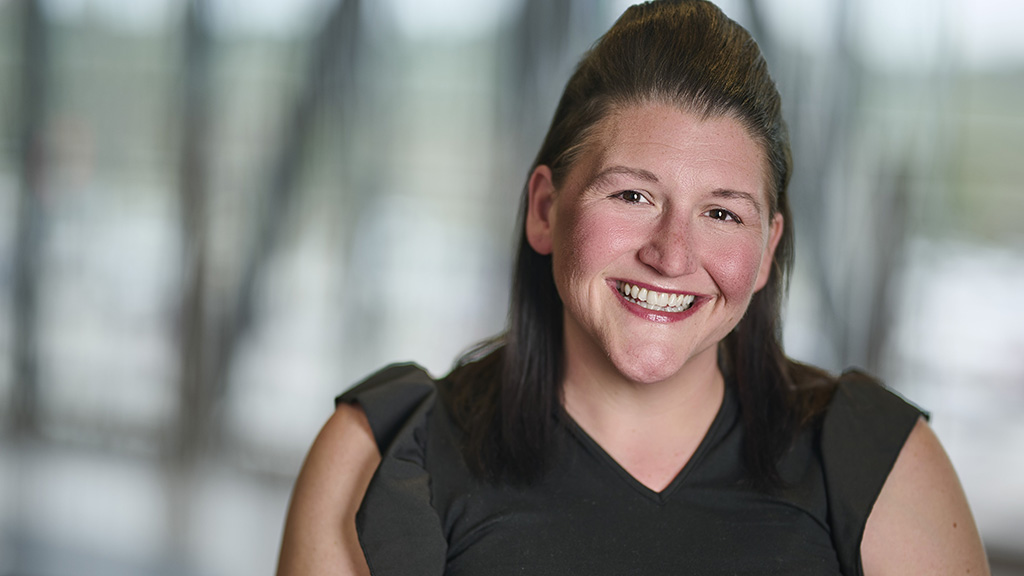
At 40, her first mammogram changed everything: LMH Health nurse urges others to get screened
Holly Dawson expected her first mammogram to be uneventful. At 40, she had no symptoms, no known family history of breast cancer and no reason to expect the screening would find anything concerning.
She might even have put it off a year or two if her LMH Health primary care physician, Dr. Caitlin Elmore, hadn’t reminded her that turning 40 meant it was time for a mammogram. She mentioned it to an older coworker who admitted she was overdue for her own first screening, so the two made a pact to schedule together and hold each other accountable.
“I was honestly more concerned they would find something on her mammogram than mine,” Dawson said. “I had zero worries for myself. I thought I would get it done, everything would be fine and I could check it off my to-do list for a while.”
A call she did not expect
Dawson had her screening mammogram on May 14. Two hours later, she received a call saying the mammogram showed a suspicious area that required additional imaging.
A diagnostic mammogram and ultrasound followed two days later, then a biopsy on May 18. The next day, Dr. Jennifer Hawasli, a breast surgeon with Lawrence Breast Specialists, called with the diagnosis. It was breast cancer.
“I was in absolute shock,” Dawson said. “I could not have been more stunned if someone had punched me in the face. I kept thinking there had to be a mistake.”
She met with Hawasli the following day. Although Dawson is a registered nurse who has worked at LMH Health for 20 years, breast cancer was unfamiliar and uncomfortable territory. Hawasli explained that an MRI would provide a clearer picture of the cancer to help guide treatment decisions.
When a small finding became a bigger decision
From the mammogram, it initially appeared that Dawson had one small tumor. However, the MRI revealed a second tumor in the same breast – together equating to roughly half her breast – as well as an abnormal area in the other breast that required further evaluation.
“That was when I finally broke down because I knew a lumpectomy was no longer an option and that I would be losing my breasts,” she said. “I remember looking at Dr. Hawasli and breaking into tears, asking if I was going to be okay. My mind went straight to my young kids who were just 5 and 8, and in that moment, I had no idea how I would tell them or how I would make sure they were cared for during my treatment.”
After discussing her options, she chose to proceed with a double mastectomy performed by Hawasli. During the same procedure, Dr. Scarlett Aldrich, a surgeon with Plastic Surgery Specialists of Lawrence, began the reconstruction process, which will require multiple procedures. Dawson’s next surgery is scheduled for November.
The pathology results after her double mastectomy brought welcome news: Dawson’s lymph nodes showed no evidence of cancer, meaning it hadn’t spread.
“Because her cancer was detected before she had symptoms, we diagnosed it at stage I,” Hawasli said. “The earlier breast cancer is detected, the more treatment options we have – and in Holly’s case, she was able to undergo surgery and medical treatment without requiring radiation or chemotherapy.”
Dawson’s experience is an important example of how routine screening can make a meaningful difference in both treatment and outlook. As Hawasli noted, “Most women diagnosed with breast cancer have no known family history, so its absence should not be a reason to delay or skip screening.”
Care coordinated around the patient
Dawson has had a team of cancer care specialists guiding her through treatment since the day she was diagnosed. In addition to breast surgery, she is receiving hormone therapy and regular follow-up care with Dr. Sharon Soule, her oncologist at the LMH Health Cancer Center. She has also seen a lymphedema specialist and a social worker, and she received genetic counseling through LMH Health’s genetic testing partner. Three nurse navigators have supported her throughout different phases of treatment, working together to coordinate her care and help her understand what to expect at each step.
Her follow-up care extends beyond breast cancer. Genetic testing revealed a mutation in the RAD51D gene that increases her risk of future breast cancer and significantly increases her lifetime risk of developing ovarian cancer.
“Knowing she has this mutation lets us pursue more aggressive breast and ovarian cancer screening and discuss preventive surgery that could lower her risk of future cancers,” Soule said.
“I cannot rave enough about the whole LMH Health Cancer Center team,” Dawson said. “Everyone was so kind and empathetic from the very start – they even gave me a special book to help me explain this to my children, which was so helpful. The way they communicated with me and coordinated everything made me feel very cared for. It’s one of many reasons I am proud to work at LMH Health.”
Receiving care in Lawrence also kept Dawson near her children and extended family. She can step away from work for follow-up appointments and return without losing a large portion of her day to travel.
“I never considered going anywhere else for my breast cancer care,” she said. “We have a stellar program here, and staying close to home means less time away from my kids and family when we needed each other most.”
A new view of her own patients
As the total joint replacement nurse navigator at OrthoKansas, Dawson helps patients prepare for surgery and recovery every day. Needing help herself during six weeks of restrictions after surgery gave her new insight into how vulnerable the recovery period can feel. Soreness and limits on lifting and arm movement meant she required assistance with many tasks, from shopping, cooking and housecleaning to washing her hair and getting to and from her appointments.
“I understand surgical patients’ needs on a deeper, more personal level now, and it has me thinking about how we can bring people together around a shared experience and help them build their own community of support after joint surgery,” she said. “Now that I’m back at work, I am exploring ways to bring that to life.”
One mammogram’s ripple effect
Sharing her experience has already encouraged people in Dawson’s life to act. Friends and family have told her they scheduled screenings immediately after hearing about her diagnosis. That includes her mother, who has also been diagnosed with breast cancer and is now receiving treatment with a good prognosis.
The whole experience transformed what Dawson thought she knew about her risk factors. It gave her family important information that can help guide future screening and health decisions for her daughter, nieces and other female relatives.
“Once we identify a genetic mutation like hers – a mutation that essentially caused her cancer – we know there’s a 50/50 chance her children, siblings and other family members have it as well,” Soule explained. “We recommend that all interested members of the family undergo testing for the gene mutation, which is made available to them free of charge. If other female family members have it, they should have a discussion with their physicians about appropriate prevention or screening.”
As Breast Cancer Awareness Month begins, Dawson hopes her story will persuade more people to get their mammograms on time, every time.
“I keep coming back to how grateful I am that I went for my mammogram when I did,” she said. “If I had pushed it off even for a few months, we could be having a very different conversation right now.”
Elmore, as her primary care physician, agrees.
“I tell my patients a lot can happen in breast health in just one year, which is why annual mammograms starting at age 40 are so important,” she said. “Just look at Holly’s case – this was her very first mammogram and it was positive. A devastating result for your first mammogram, but I am so glad she went and had it done instead of waiting until the next year.”
Screening mammograms do not require a doctor’s order, and scheduling is easy. Dawson’s advice to other women is simple: “Life is busy, but please take the time. The mammogram was nothing like the ‘panini press’ horror stories I had heard, so don’t be afraid to get it done. It is better to know than not know, and if you do find out you have cancer, you will have an amazing team behind you.”
Diane Morgan is a freelance writer covering health, wellness and community topics for LMH Health.
Screening saves lives
To schedule a mammogram with LMH Health, call 785-505-3300. Cost should never be a barrier to breast cancer screening. To learn how to obtain a mammography voucher, call 785-505-5782. To make a gift to support breast cancer screening, please visit lmh.org/donate.
For media inquiries related to LMH Health contact:
Autumn Bishop – Strategic Communications Manager