Earlier detection, clearer answers: Advancing lung cancer care at LMH Health
In the U.S. today, someone is diagnosed with lung cancer about every two minutes, according to the American Lung Association (ALA). Because it often goes undetected until later stages, lung cancer is the leading cause of cancer deaths, claiming hundreds of lives every day.
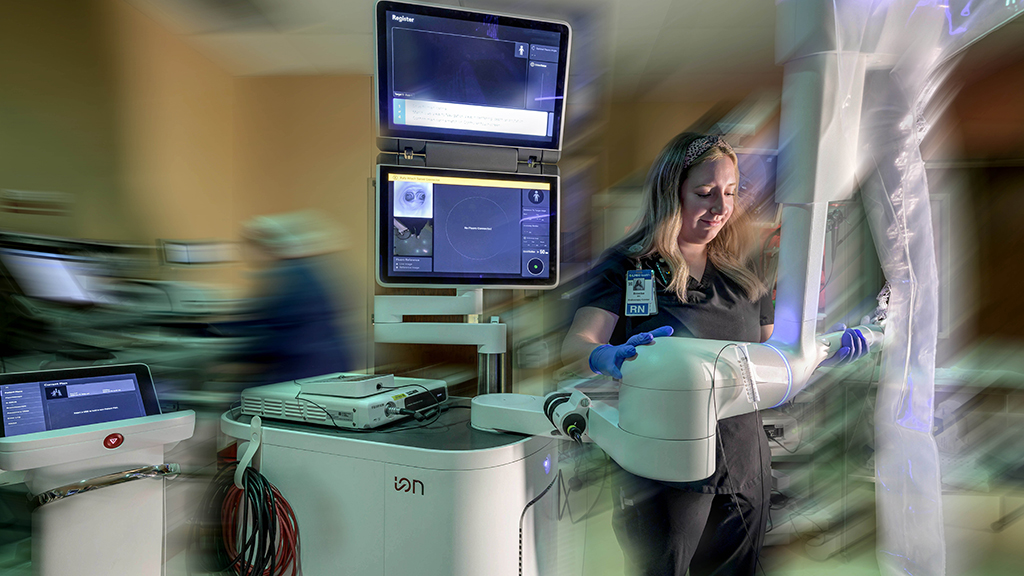
Fortunately, advances in local screening and diagnostic technology offer hope. At LMH Health, low-dose computed tomography (low-dose CT) is used to reveal suspicious changes before symptoms develop. When CT findings require a closer look, pulmonologists use Ion robotic bronchoscopy to reach small areas deep within the lungs and collect tissue for diagnosis.

“For patients, finding something on an X-ray or scan is the beginning of many questions,” said Dr. Vance Burns, a board-certified pulmonologist with Lawrence Pulmonary Specialists. “These tools help us identify concerns earlier and get the information we need to guide their next steps.”
Why earlier detection matters
Lung cancer can form without causing noticeable symptoms. The timing of a diagnosis makes a substantial difference in treatment options and outcomes: The ALA’s 2025 State of Lung Cancer report puts five-year survival at 65% for people diagnosed at an early stage, compared with 10% for those diagnosed at a late stage.
Screening offers a chance to find the disease early, potentially reducing lung cancer deaths by up to 20% among people at high risk. Despite this, less than 1 in 5 eligible people were screened in 2022, the most recent year of data available for ALA’s 2025 report.
“It’s understandable to be afraid of what a scan might find, but finding a problem earlier may give us more ways to treat it,” Burns said. “If you’re worried about screening, we can talk through those concerns and explain what to expect.”
Who qualifies for lung cancer screening
LMH Health practitioners generally recommend annual screening for adults ages 50-77 who currently smoke or quit within the past 15 years, have no symptoms of lung disease, and have a smoking history of at least 20 pack-years. (A pack-year is a way of measuring a person’s smoking habit over time; for example, one pack a day for 20 years equals 20 pack-years, as does half a pack a day for 40 years or two packs a day for 10 years.)
“People who quit smoking have taken an important step for their health, but they may still benefit from lung cancer screening,” Burns said. “Whatever your smoking history, you deserve care and support, so sharing that information helps us understand your risk and recommend the right next steps.”
The screening involves low-dose CT to create detailed images of the lungs using less radiation than a standard diagnostic CT scan. It is painless, requires no injections and takes only a few minutes. Patients lie on a table that moves through the scanner, briefly holding their breath while images are taken. Patients can return to normal activities immediately afterward.
When the screening raises questions
Once the CT scan is complete, a radiologist reviews the images for lung nodules or other concerns. Many lung nodules are noncancerous and may result from previous infections or inflammation.
Depending on its size, appearance and other factors, a nodule may need monitoring with another CT scan. If it requires further evaluation, the care team may recommend a biopsy to collect tissue for laboratory analysis.
“A nodule is a finding, not a cancer diagnosis,” Burns said. “Some can be watched over time, while others need more testing. We explain why we’re recommending a particular approach, so patients know what we’re looking for and what to expect next.”
Accessing difficult areas with robotic technology
Bronchoscopy is a minimally invasive procedure that uses a thin, flexible tube with a tiny camera to examine the airways and collect biopsy samples if needed. Because some lung nodules are very small or located deep within the lungs, they can be hard to reach with traditional bronchoscopy.
Enter Ion robotic bronchoscopy, which now gives LMH Health pulmonologists a state-of-the-art alternative. The Ion technology adds robotic-assisted navigation and a highly maneuverable catheter that the pulmonologist controls to reach suspicious nodules.
“A scan can show us where a concern is, but sometimes we need tissue to understand exactly what it is,” Burns said. “For some patients, Ion offers a way to get those answers without a more invasive surgical biopsy.”
Bronchoscopies are typically outpatient procedures performed with sedation or general anesthesia. Most patients go home the same day, and biopsy results are available within a few business days.
Community investment in local care
The Ion robotic bronchoscopy system was made possible in part through the generous support of LMH Health Foundation donors, helping to expand local access to lung cancer diagnostics. Investments like these make it possible for more people in and around Douglas County to receive exceptional diagnostic support close to home.
“When someone is facing a potential cancer diagnosis, travel and unfamiliar surroundings can add to the stress,” Burns said. “Generous donor support has helped us offer more options in Lawrence, so patients can stay closer to their families and the care teams they know.”
November is Lung Cancer Awareness Month, a good time to understand how screening and advances in biopsy technology can make a difference and save lives. If you think you qualify for annual lung cancer screenings, talk to your primary care practitioner. Referrals are required, and insurance coverage varies. When cost is a barrier, financial assistance may be available from LMH Health Foundation.
Diane Morgan is a freelance writer covering health, wellness and community topics for LMH Health.
For media inquiries related to LMH Health contact:
Autumn Bishop – Strategic Communications Manager